The Fed Just Raised Rates. Here's the First Thing a Trained Trader Checks.
Last week the Federal Reserve raised interest rates for the first time in nearly three years, to a range of 3.75% to 4.00%.
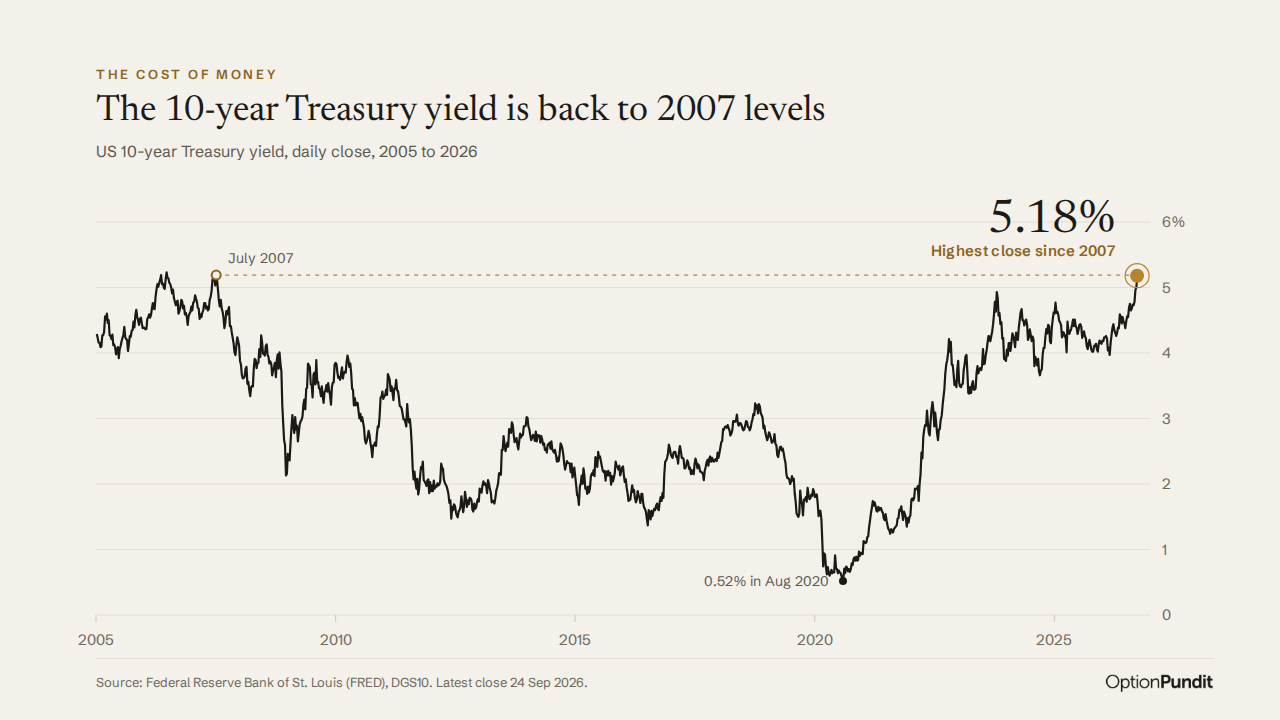
The 10-year US Treasury yield briefly touched 5.23% during trading and closed at 5.18%, its highest close since 2007. The average 30-year mortgage rate jumped to 7.45%, a two-year high. On Monday, stocks and bonds both fell as tensions over the Strait of Hormuz flared again.
And yet, over the same week, the S&P 500 rose 1.2% and the Nasdaq rose more than 2%.
So which is it? Is this market strong, or nervous?
If you're not sure, good. That's the right question. And the way you answer it decides which trades will work for you over the next few weeks, far more than which stock you pick.
This post walks you through the first step every one of our students takes before any trade. It's simple, it takes a few minutes, and once you start doing it you'll wonder how you ever traded without it.
Same trade, different market
Here's something that surprises people when they first learn it.
A trade that works beautifully in a calm, rising market can fail in a nervous one. Not because the idea was bad. Not because the stock was wrong. Because the market around the trade changed, and the trader didn't notice.
Think of it like driving. The same road feels completely different in sunshine and in a storm. A good driver doesn't change the destination. They change the speed, the distance to the car in front, and how hard they brake. They adjust to the conditions first.
Trading works the same way. That's why the process we teach starts with the weather, not the car.
We call it CLEAR:
- Check the conditions
- Locate the opportunity
- Enter the right trade
- Allocate your risk
- Review and improve
Five steps, in that order, every time. This week we're going deep on the first one, because it's the one this week's news is shouting about.
The three things to check before your next trade
You don't need a dozen indicators to read the market's conditions. You need answers to three plain questions.
1. What is money costing right now?
Interest rates are the price of money. When they rise, borrowing costs more for companies, for home buyers, and for anyone carrying debt. Businesses tend to spend more carefully. Investors start comparing stock returns with what they can earn from safer places, like bonds.
The result is often a jumpier market. Not always a falling one, but one that reacts more sharply to bad news.
Where we are this week: rates are rising. The Fed has just raised rates, and long-term yields are back at levels last seen in 2007. That's a big shift from the conditions many newer traders have ever traded in.
2. Who is doing the lifting?
When you hear "the market is up," that usually means an index like the S&P 500 is up. But an index can rise while most of the stocks inside it go nowhere, if a handful of very large companies are doing all the work.
Traders call this market breadth: how many stocks are joining the move.
- Wide breadth: most stocks are rising together. The move has broad support.
- Narrow breadth: a few giants carry the index while many stocks lag. The index looks healthier than the average stock.
Where we are this week: narrow. Only about 27% of stocks are trading above their 50-day average, even while the S&P 500 climbs. Small companies fell last week as the big names rose.
Why does this matter to you? Because if you trade individual stocks, you're not trading the index. In a narrow market, the stock you like has a good chance of being one of the laggards, even when the headlines say "market up."
3. What is the mood?
The market's mood shows up in volatility: how big the price swings are, and how big traders expect them to be. The best-known measure is the VIX, often called the market's fear gauge. It's calculated from S&P 500 option prices and reflects how much movement traders expect over the next 30 days.
This check matters especially for option traders, because volatility is part of the price of every option.
- When nerves rise, option prices rise. Protection costs more, and people selling options are paid more.
- When the market calms, option prices shrink.
So the mood doesn't just tell you how the market feels. It changes whether you'd rather be buying options or selling them, and how much room you give each trade.
Where we are this week: uneasy. Rising rates, oil tension around the Strait of Hormuz, and a jobs report on Friday all give the market reasons to swing.
Putting the picture together
Now combine the three answers:
| Check | This week |
|---|---|
| What is money costing? | Rising |
| Who is doing the lifting? | A few large companies |
| What is the mood? | Uneasy |
That's your picture of the market: rising rates, a narrow market, an uneasy mood.
Notice what this is not. It isn't a prediction. It doesn't say the market will go up or down tomorrow. It's a description of the conditions you're about to trade in, and it's the frame every other decision sits inside.
Two traders, one Monday morning
Meet two traders. Both have done their homework on the same company, and both believe the stock will rise over the next month.
The first trader sees the index is up, feels good about the market, and buys straight away. Same position size as always. Same trade that worked for them in the spring.
The second trader checks the conditions first. Rates rising. A narrow market where many stocks are lagging. An uneasy mood with big data coming on Friday. So they still act on their idea, but they choose a trade built for this market. They size it with the swings in mind. They know in advance what they'll do if Friday's number surprises.
Same stock. Same idea. Same week.
If the market stays calm, both might do fine. But if the jobs report shakes things up, or oil jumps again, the first trader is suddenly reacting, while the second trader is simply following a plan.
That's the difference conditions make. Not a better stock pick. A trade that fits the market it lives in.
A real example of what process does
John Chong works full time as an IT professional. He didn't have hours a day to watch screens, and he didn't want tips. He wanted a process he could run around his job.
Once he learned one, he built US$80,000 in six months, trading options part time.
The lesson isn't the number. It's that a clear, repeatable process, starting with reading the conditions, is what let someone with a full-time job trade with confidence instead of guesswork.
Individual experiences. Not typical, and not a guarantee of future results.
So what do you do now?
Start with one small habit this week.
Before every trade, write one line:
"Conditions today are ______."
Rising or falling rates. Wide or narrow market. Calm or uneasy mood. One sentence.
If you can fill it in, you're already trading with more awareness than you were last week.
If you can't, that's useful too. You've just found your first leak, and it's an easy one to plug.
Checking the conditions is step one. The other four steps are where that picture becomes a trade:
- Locate the opportunities that fit these conditions.
- Enter the trade structure that suits them.
- Allocate your risk so no single trade can hurt you badly.
- Review every trade so you get better each month.
That's the full system, and it's what turns occasional wins into consistent results.
Learn the full picture, free
In my free class, Options Trading Made Easy, I show you the 3 strategies to start a new income stream, and how the five CLEAR steps fit around them. It works even if you're starting from scratch.
It's on demand, so you can watch it tonight.
Frequently asked questions
Does a Fed rate hike change option prices?
A little, directly. Higher rates nudge call prices up and put prices down slightly. The bigger effect is indirect: rate changes move the market's mood, and the mood (volatility) moves option prices much more. That's why checking volatility is one of the three checks.
What is market breadth, in simple terms?
It's how many stocks are taking part in a move. If the index rises but most stocks don't, breadth is narrow. It's a quick way to see whether "the market is up" is true for the stocks you actually trade.
What does the VIX tell me?
It shows how much movement traders expect in the S&P 500 over the next 30 days, based on option prices. Higher means more nervous. For option traders, it's a direct clue to whether options are cheap or expensive right now.
Do I need to watch the markets all day to do this?
No. The three checks take a few minutes, once a day or before you trade. Our students learn to run their whole routine in about two hours a week.
I'm over 55. Is it too late to start?
No. Some of our strongest students started or rebuilt their trading in their 50s and 60s. What matters isn't your age. It's having a clear process and a coach who has done it.
Is this a prediction about the market?
No. Checking conditions describes the market you're trading in today. It doesn't tell you where prices go next. It helps you choose trades that fit, whatever happens.
Nearly 20 years of teaching. 10,000+ traders in 18+ countries.