Is the AI Trade Over? Read This Before You Sell, or Buy the Dip
In a few weeks, the market went from punishing AI companies for spending too much to punishing them for spending too little. Here's what that flip tells you, and three questions to ask before you touch an AI stock this week.
Earlier this month, the fear was about the bill. The giants were spending too much on AI, borrowing costs were rising, and nobody could say when it would pay back.
Last week, the fear flipped. Tesla cut its full-year spending plan by a fifth, Meta said little about what comes next, and the market panicked about the opposite problem, as Capital.com analyst Kyle Rodda put it: what if the AI spending boom has already peaked?
Same stocks. Opposite story. Same result: red screens.
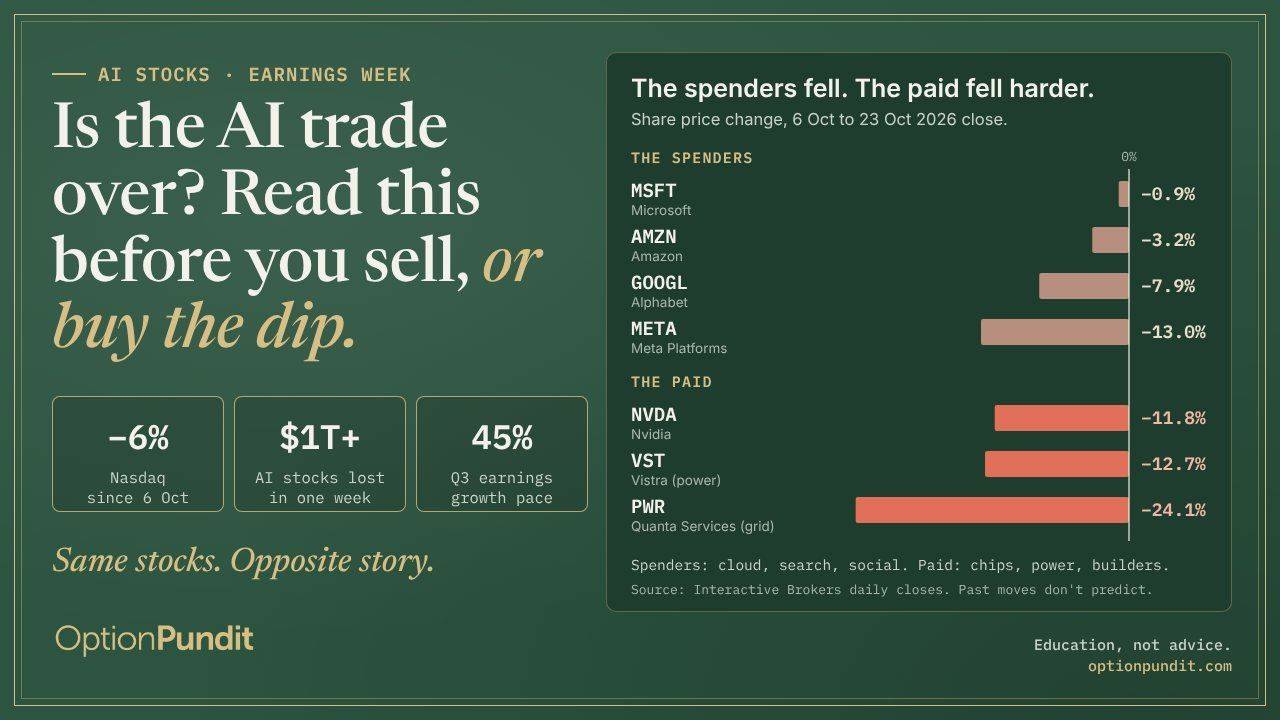
Since 6 October, the Nasdaq has fallen about 6%, and Meta and Nvidia are down 12 to 13% (Business Today). Alphabet is down about 8%. In a single week in mid-October, the 20 most valuable AI and chip stocks lost more than a trillion dollars in value between them (CNBC).
This week is the big one. Microsoft and Alphabet report on 27 October, the Fed decides on rates on the 28th, and Amazon reports on the 29th. If you own any of these, or you've been waiting to buy, the headlines will tempt you to act.
Before you do, here's how I read a sell-off like this.
The story changes after the price does
After 20 years of watching markets, one pattern keeps repeating. The price moves first, and the explanation gets written afterwards. When stocks fall on "too much spending" and then fall again on "too little spending", the reasons aren't driving the price. The selling is. The reasons are just the caption.
That doesn't mean the worries are wrong. It means a headline is the worst place to make a decision from.
Here's what the headlines skip. Nasdaq-100 companies are on pace for about 45% earnings growth this quarter (Nasdaq). The businesses aren't shrinking. What has changed is how much investors will pay for them, and how nervous they feel about the bill for the build-out.
"AI stocks" are not one trade
The most common mistake I see is treating AI as one bet. It isn't. Follow the money and you find two sides.
The spenders. These are the giants writing the cheques: cloud, search and social media. Their worry is whether the spending pays back.
The paid. These are the companies cashing those cheques: chips, memory, networking, power, cooling, and the firms that build the data centres. Their worry is the next order.
When the market fears too much spending, the spenders take the hit. When it fears too little, the paid get hit hardest. That's what happened last week. Power and construction stocks tied to data centres fell sharply in a single session, with Vistra down more than 10% and Quanta Services down more than 8% (CNBC).
Step back and the gap is even starker. From 6 to 23 October, Quanta Services, which builds the power lines and grid connections that data centres need, fell 24%. Microsoft, one of the biggest spenders of all, fell less than 1% (Interactive Brokers closing prices). Same theme, same three weeks, a 23-point gap.
That's the idea behind our AI Capex Map. It follows where AI spending flows and maps the sectors, industries and stocks on the receiving end. Once you know which side of the money a stock sits on, a week like this one stops being noise and starts being information.
Three questions to ask before you sell, or buy the dip
1. Which side of the money is this stock on?
A spender and a supplier can fall on the same day for opposite reasons. If you don't know which one you own, you can't tell whether the news hurts it or helps it.
2. Has the money changed, or only the mood?
This week answers that. When Microsoft, Alphabet and Amazon report, look past the first move and find one thing: what they say about next year's spending. If the plans hold, the "boom has peaked" story weakens. If they cut, the suppliers feel it first. Either way, you'll be acting on a fact instead of a feeling.
3. What will it cost you to be wrong?
This is the question most people skip. It decides whether a bad month is a bruise or a scar, and the arithmetic is unforgiving:
- A 12% fall needs a 13.6% gain just to get back to even.
- A 30% fall needs 43%.
- A 50% fall needs 100%.
If you own a stock outright and it drops 12% in three weeks, the whole drop lands on you. Then you wait for the market to give it back.
Knowing the names is not a trade
Here's what this sell-off is really telling you. Being right about AI was never the hard part. Plenty of people knew the names. The hard part is how you hold them.
Owning AI stocks outright is the most expensive way to play the theme. You pay full price, you take every fall in full, and while you wait for the recovery, the stock pays you little or nothing.
There are other ways the market can pay you while you wait. Accredited investors and their private banks have used them for decades.
That's what we'll show you in our free live masterclass, Three More Paychecks From the Financial Markets, on Saturday 31 October at 10am Singapore time. You'll learn the three ways the stock market can pay you, including the one most investors are never shown. You'll also learn to spot the chasing trap, which catches people on the way down as often as on the way up. We'll walk through the AI Capex Map live, and everyone who attends gets our full AI desk note.
The calm way through a loud week
Weeks like this reward the investor with a process, not the one with the fastest reaction. Know which side of the money you're on, wait for the facts, and size every position so that being wrong is survivable. The headlines will change again by Friday. Your process shouldn't.
The Weekly Edge · free, every Sunday
Get one clear read of the market every Sunday.
What moved, why it matters, and what we're watching next. Free. Join 40,000+ traders.
Happy trading,
The OptionPundit team
Sources
- Kyle Rodda, Capital.com, quoted in Yahoo Finance, Stock Market Today (23 Oct 2026): Nasdaq falls following tech sell-off.
- Business Today, AI trade unravels (26 Oct 2026): Nasdaq, Meta, Nvidia and Alphabet moves since 6 October.
- CNBC, Nvidia, AMD, Dell sink in global tech rout on AI funding worries (15 Oct 2026): the trillion-dollar week.
- CNBC, stock market live updates (21 Oct 2026): Vistra and Quanta Services in a single session.
- Nasdaq, Chartstopper (23 Oct 2026): Nasdaq-100 third-quarter earnings growth pace.
- Rankia, earnings and Fed calendar for October 2026: Microsoft, Alphabet and Amazon report dates, and the Fed decision date.
- Interactive Brokers daily closing prices, 6 to 23 Oct 2026: Quanta Services and Microsoft share price changes.
- Recovery figures are arithmetic: gain needed = loss ÷ (1 − loss).
Education, not advice. This is not a recommendation to buy or sell any security. Past moves don't predict future results.